Goodies · free to grab & share
Posters, printables, all yours.
Seasonal posters to send to the group chat, plus print-ready starter materials — no sign-up, no cost, no catch. 💌 Each printable is a web page that prints clean: open it, hit Print, and the website chrome drops away. No PDFs to wrangle.
Seasonal posters
The flavor of the month, and every season before it.
Every night gets its own poster — composed live in our own type, each with a scan-to-RSVP code. Tap one, send it to the group chat, screenshot to share. 💌

Mahjong for the Girls
It’s a Mahj Hot Summer
Mahjong margaritas, poolside tiles.
Seattle
mahjongforthegirls.com
@mahjongforthegirls
Scan to RSVP

Summer 2026
Mahjong margaritas, poolside tiles.

Mahjong for the Girls
Disco Mahj
A sparkly mahjong night.
Seattle
mahjongforthegirls.com
@mahjongforthegirls
Scan to RSVP

Disco Night
A sparkly mahjong night.
Mahjong for the Girls
Mahj on the Wild Side
A walk on the wild side.
Seattle
mahjongforthegirls.com
@mahjongforthegirls
Scan to RSVP

Wild Side
A walk on the wild side.

Mahjong for the Girls
Rise & Mahj
Mimosas + mahjong.
Seattle
mahjongforthegirls.com
@mahjongforthegirls
Scan to RSVP

Rise & Mahj
Mimosas + mahjong.
Printables
Print-ready starter materials.
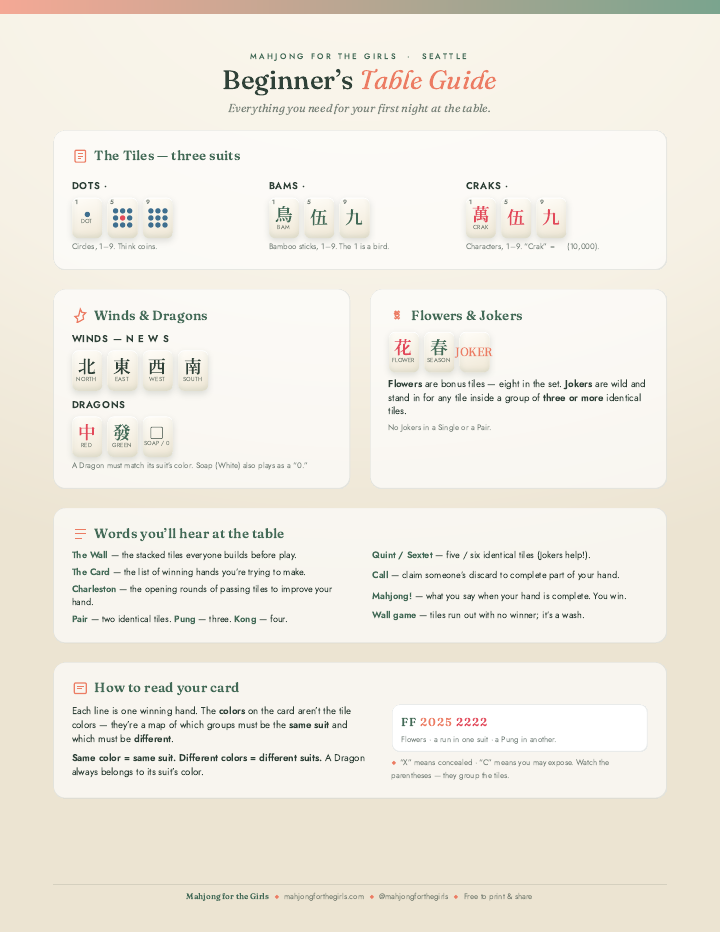
Beginner's Table Guide
2 pages · Letter · double-sided
Tiles, dragons, the Charleston, and how to read your card — everything for a first night, on two pages.
Read & print the guide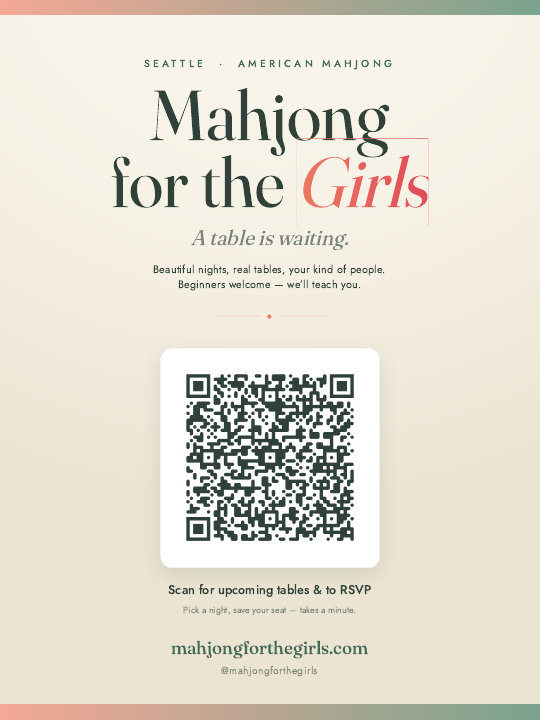
QR Invite Poster
Print any size · scan to RSVP
Pin it up anywhere. A big, friendly QR code drops people straight onto the calendar to save a seat.
Open & print the invite →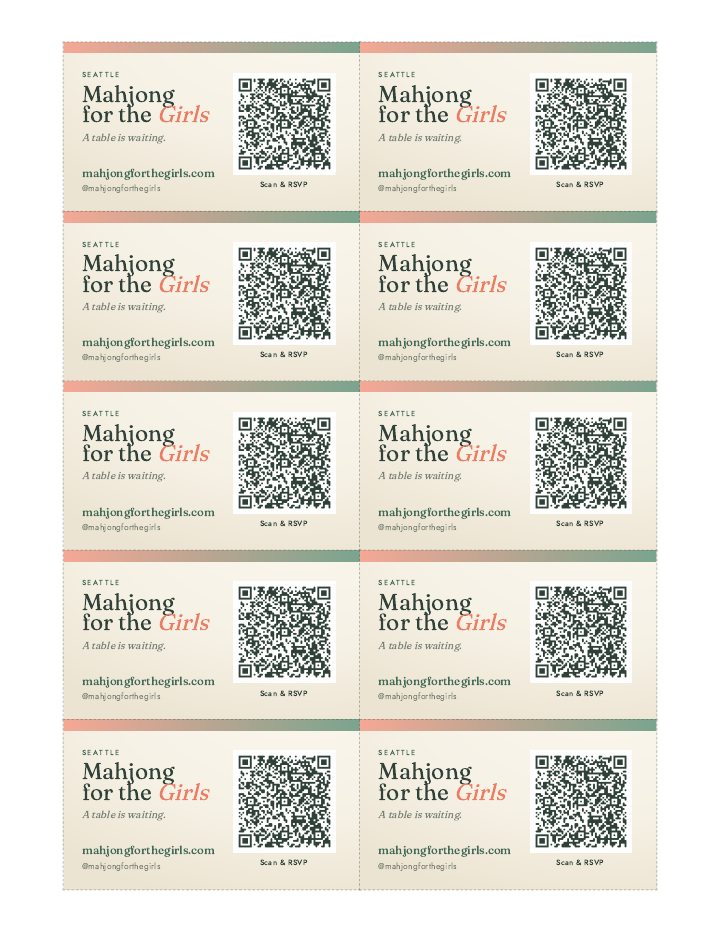
Business Cards
Prints 10 to a sheet · 3.5 × 2 in
Slip one to anyone who asks about the table. Hitting print lays out a full cut-it-yourself sheet of ten.
Open & print the cards →Read it here
The Beginner’s Table Guide
Part one
Meet the tiles
A full American set is 152 tiles: three numbered suits, the Winds and Dragons, plus Flowers and Jokers. Here’s the whole cast.
The three suits
Dots are circles, like coins. Bams are bamboo — the 1 Bam is drawn as a little bird. Craks carry the character 萬 (“ten thousand”). Every suit runs 1 through 9, with four copies of each tile.
Winds & Dragons
Four Winds — North, East, West, South — and three Dragons: Red (pairs with Craks), Green (with Bams), and White, the blank tile called Soap, which doubles as a zero.
Flowers & Jokers
Eight Flowers are bonus tiles — some hands ask for them. Jokers are wild and can stand in for any tile, but only inside a group of three or more identical tiles — never in a Single or a Pair.
How to read your card
Each line on the card is one winning hand. The colored numbers aren’t tile colors — they’re a key for which groups share a suit and which must differ.
FF 2025 2222
Two Flowers · a run reading 2-0-2-5 in one suit · a Kong of 2s in another.
Same color = same suit. Different colors = different suits. A Dragon follows the suit of its color. Watch the spacing — it tells you where one group ends and the next begins.
The building blocks — hand shapes
Every hand on the card is built from a handful of repeating shapes. Learn these seven and you can read any line.
Single
1 tile
Pair
2 alike
Run
sequence
Pung
3 alike
Kong
4 alike
Bigger groups exist too — a Quint is five alike and a Sextet is six, usually leaning on a Joker or two. Pairs and Singles never take a Joker.
Words you’ll hear at the table
East — the dealer; East opens every hand.
The Wall — the stacked tiles everyone builds before play.
The Card — the list of winning hands you’re trying to make.
Charleston — the opening rounds of passing tiles to improve your hand.
Discard — the tile you set out, face-up and named, to end your turn.
Call — claim the tile someone just discarded to complete a group.
Pair / Pung / Kong — two / three / four identical tiles.
Mahjong! — what you say when your hand is complete. You win.
Wall game — tiles run out with no winner; the hand is a wash.
Part two
From shuffle to Mahjong!
Setting up
- Build the wall. Shuffle face-down; each player stacks a wall in front of their rack, 19 tiles across and two high.
- Sort as you go. A tidy rack — Jokers, Flowers, suits grouped with their matching Dragons, then Winds in N-E-W-S order — makes the card far easier to read.
- Pick your target. Find the line on the card your tiles come closest to, and aim for it. You can change your mind during the Charleston.
The deal
East rolls both dice and counts that many stacks in from the right end of their own wall — that’s where the wall is broken.
Starting at the break, East takes the first two stacks (four tiles), the next player takes two, and so on around the table until everyone holds twelve. East then takes the 1st and 3rd tiles from the top of the next stacks to reach 14; everyone else draws one more for 13.
The Charleston
Before play, tiles get passed around to sweeten every hand — three tiles at each step.
First Charleston (required): pass right, then across, then left.
Second Charleston (optional): left, across, right — any player may call it off before it starts. The first left and the last right may be blind passes.
Finish with an optional courtesy pass of zero to three tiles with the player across from you.
Your turn, around the table
- East starts. East opens play by discarding one tile face-up and naming it.
- Draw, then discard. On your turn draw the next wall tile, swap for a Joker if you can, then discard one and say its name. Play moves to the right.
- Call a discard. Need the tile just thrown? Call it before the next draw, expose the group it completes, then discard.
- Win the hand. Assemble the full 14 tiles of a line on the card and call “Mahjong!”
Quick reminders
- 🔍 When in doubt, count. Confirm a group before you call it.
- ⭐ Jokers need a crowd. Only inside groups of three or more.
- 👀 Watch the spacing. On the card it tells you where each group ends.
- ↪️ Walls left, play right. Turns travel to the right around the table.
A table is waiting.
Come learn in person — beginners always welcome. Scan to see upcoming nights and save your seat.
mahjongforthegirls.com · @mahjongforthegirls

New to the card? The official hands card is published each spring by the National Mah Jongg League — proceeds go to charity.